The Escuela Bolera: What It Is and Its Origins
There is a way of dancing in Spain that confuses a lot of people. It isn’t flamenco, it isn’t classical ballet, and it isn’t your typical small-town folk dance. It draws from all three, yes, but it completely dances to its own beat. It’s called escuela bolera. A couple of centuries ago, everyone knew it because it packed entire theaters. Today, outside of professional circles, barely anyone talks about it. But if you look closely at Spanish dance today, you’ll see it left a massive footprint.
What Is Escuela Bolera?
It’s easy to sum up: take the technical control of ballet and inject it with the sheer playfulness and soul of the Spanish streets. The result is a refined style packed with tricky jumps, lightning-fast turns, and one sacred rule: your hands are never free, they are always playing castanets.
In flamenco, the artist improvises heavily, chasing that raw emotional spark in the moment. Not here. Escuela bolera is studied like a musical score. Every single movement is measured to the millimeter. In fact, the steps have fixed names taught exactly the same way for generations, like la vuelta lisa, el bien parado, or el sostenido. The choreographies are locked down, with a rigid structure from start to finish.
The Differences Between Escuela Bolera and Flamenco
If it’s your first time watching a show, you will definitely confuse them. But they were born in completely opposite worlds.
Flamenco grew up from the grassroots — among Gitano families, in the countryside, and in the taverns of Andalusia. It’s pure gut, expression, and rhythm dictated by the singing. Escuela bolera, on the other hand, was invented for the stages and high-society salons of the 18th century. What the masters of that era did was take popular street dances and organize them using the rules of European classical ballet.
Yet, they don’t live in isolation. Most professional flamenco dancers train in escuela bolera because it gives them an incredible physical foundation. When you see a dancer on stage moving her arms with flawless placement or nailing a blazing turn, there are years of academy training behind it. If you want to see how this fits into the roots of pure dance, I recommend reading about the core fundamental elements of flamenco.
The Origins of Escuela Bolera
It all started in the 1700s. People danced freely in the plazas — things like boleros, seguidillas, or fandangos. Dance masters loved that street rhythm, so they brought it into their academies. They cleaned it up, added strict technique, and turned it into a stage show. Basically, they stylized the dance of the people.
A master named Rodríguez Calderón wrote a book in 1807 called La Bolerología to bring order and set the rules of the game. Madrid and Seville filled up with academies. Audiences flocked to the theaters because, deep down, they felt those steps came from their own celebrations.
French and Italian Influence on Spanish Escuela Bolera
This style didn’t grow in a bubble. Back then, Madrid was crawling with choreographers from France and Italy working in the royal theaters.
Spanish masters didn’t compete with them; they copied what worked. They grabbed the high jumps, the multiple turns, and the intricate footwork of European ballet and injected them into traditional local rhythms. What came out was a perfect blend: the discipline of Paris mixed with the fiery temperament of a Spanish fiesta.
Costumes and Repertoire of Escuela Bolera
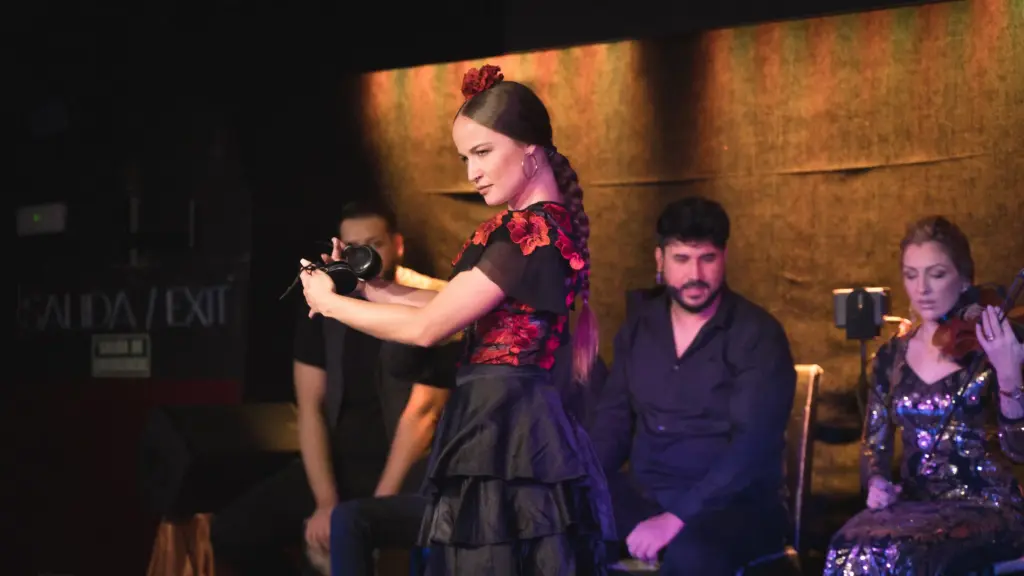
Laura Fúnez with castanets and traditional Escuela Bolera costume.
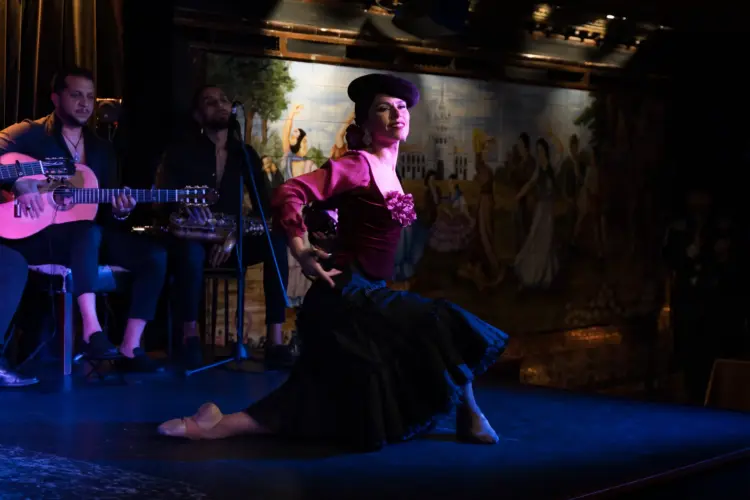
The dancer wears a flared skirt cut above the knees — essential so the audience can follow the footwork — with flat or very low-heeled shoes with crossed ribbons. And the castanets, always, from the very first second, clicking while she jumps and turns.
The repertoire holds historical pieces danced exactly the same way they were two centuries ago. These three are fundamental:
- Los panaderos: An incredibly fun, fast dance. The name comes from the Madrid bakers who used to cause a ruckus at neighborhood festivals in the 18th century. The castanets don’t stop for a single second.
- El jaleo de Jerez: The perfect bridge to the flamenco tradition. It has that flavor from Cádiz, with more groove, more cheekiness, and more freedom of movement.
- El ole de la curra: One of the oldest surviving pieces. It has an almost military, highly elegant air that demands mathematical timing.
Then there are others like el vito, las manchegas, or el zorongo. They are absolute classics in the history of our dance.
Escuela Bolera Today: A Living Tradition on Stage
Today, escuela bolera survives in official conservatories. It’s a mandatory subject for anyone studying Spanish dance, and the Ballet Nacional de España protects it fiercely on its tours.
But it’s not an archaeological museum piece. It’s alive on commercial stages. When you go watch a show and pay attention to the artists, you quickly spot who comes from the conservatory. That core stability and the clean power in their turns come straight from there.
At Tablao Flamenco 1911, the oldest venue in Madrid’s Barrio de las Letras, we look for exactly that profile. We want performers with raw flamenco fire in their veins but also the technical schooling of classical dance in their feet. In fact, when you watch our flamenco shows, that blend of academic precision and pure passion is exactly what makes the live experience feel completely different.
Buy tickets for the most authentic flamenco show in Madrid
Buy tickets
Featured posts
Flamenco shows

From 13 to 18 October
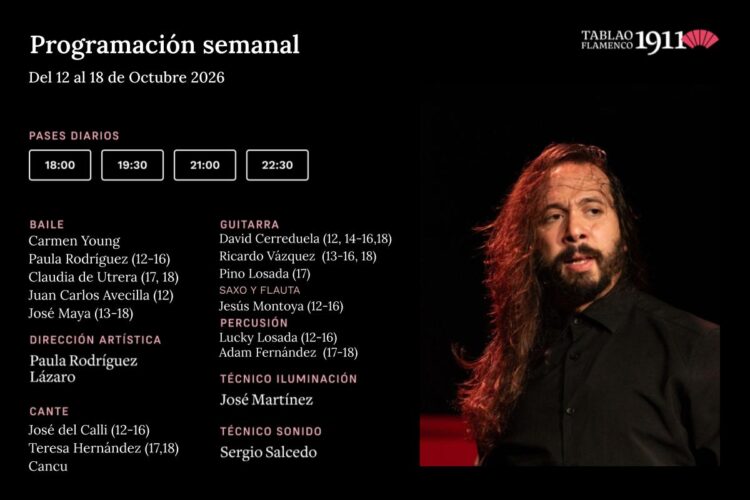
José Maya on stage at Tablao Flamenco 1911
This week, one of the most powerful names in contemporary flamenco shines once again on our stage: José Maya.
From 12 to 18 October
Flamenco Madrid Daily Show
This week, our flamenco ensemble renews itself to offer you an experience full of nuances and overflowing talent.
From 12 to 18 October
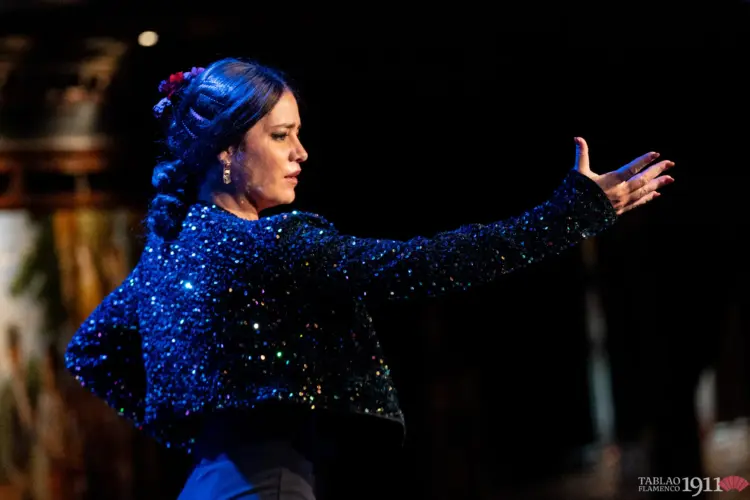
Carmen Young: elegance turned into dance at Tablao 1911
She crossed an ocean to learn to dance flamenco. Today she dances it with an elegance that can't be taught.
From 12 to 16 October
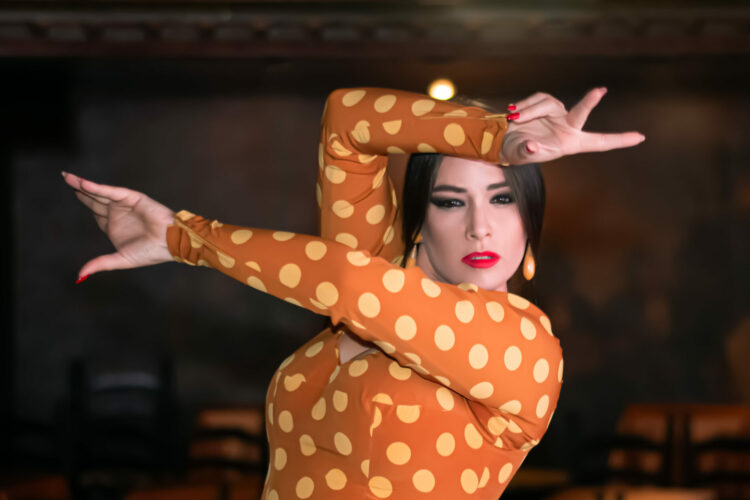
Paula Rodríguez returns to 1911
Paula Rodríguez, pure passion, strength, and elegance!
From 17 to 18 October
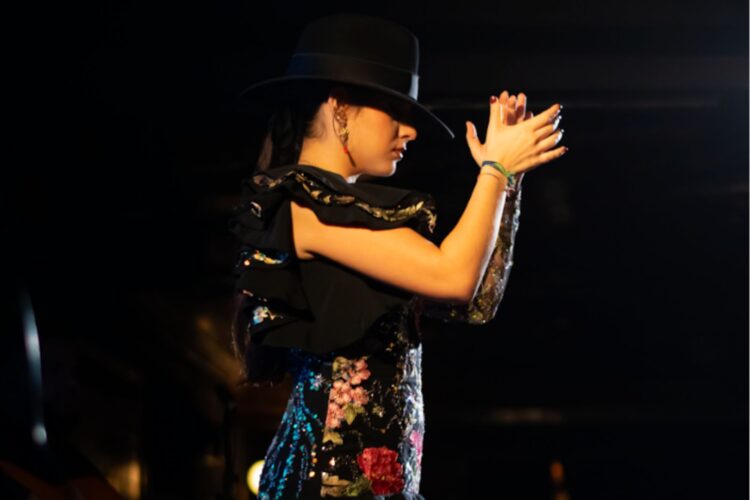
The Old Soul of a New Talent: Claudia de Utrera
We invite you to discover the strength and maturity of Claudia de Utrera, a dancer who proves that art